Humanity Invented Dark Matter (Legally Speaking) and the Universe Has Yet to Cut Us a Check
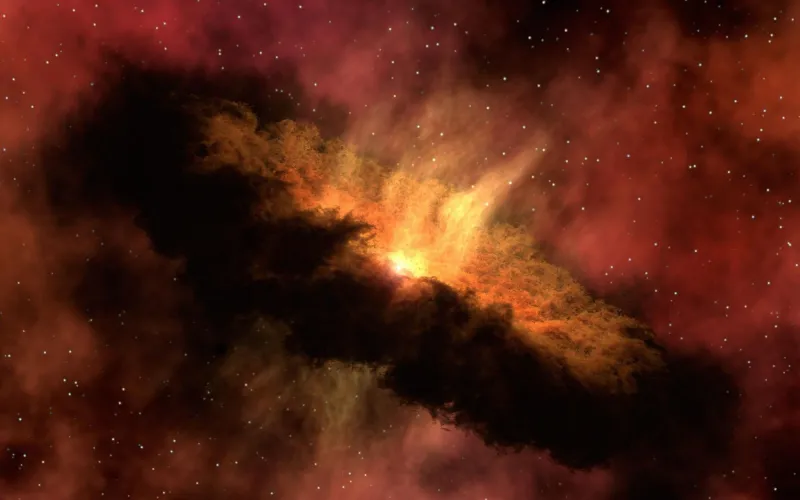
Let's get one thing straight before we proceed to discovery: dark matter did not discover itself. It did not waltz into a peer-reviewed journal, slap down a galaxy rotation curve, and announce its own existence. No. Human beings — specifically Swiss astrophysicist Fritz Zwicky in 1933, and subsequently generations of sleep-deprived graduate students — did that work. And if intellectual property law means anything in this or any other dimension, the cosmos owes us a royalty check with about ninety years of compound interest attached.
At Universe Metaphysical Lawsuit, we have retained (metaphysically speaking) some of the sharpest legal minds operating between the third and eleventh dimensions, and their conclusion is unanimous: the universe has been profiting off human observational labor without compensation, without credit, and — most damningly — without so much as a co-authorship credit on its own mass distribution.
We are filing a claim. We encourage you to join us as a class.
Establishing the Intellectual Property Framework
Under U.S. copyright and patent law, the creator of an original work or invention holds exclusive rights to its use and commercial exploitation. Now, we acknowledge that dark matter technically predates humanity by approximately 13.8 billion years. The universe's attorneys will certainly lead with this point. They always do.
However — and this is where our argument gets beautifully bulletproof — the legal existence of dark matter did not begin until humanity named it, quantified it, and built an entire sub-discipline of astrophysics around it. Before Zwicky observed the Coma Cluster's suspiciously fast-moving galaxies and declared that something invisible must be holding them together, dark matter was, for all intents and purposes, legally nonexistent. It was just the universe doing whatever it wanted with no oversight, no documentation, and certainly no regulatory compliance.
In trademark terms: we coined the brand. The universe is running a billion-dollar product line off our IP.
The Damages Are, Frankly, Astronomical
Let's talk numbers, because this is a lawsuit and lawsuits love numbers.
Dark matter is estimated to constitute approximately 27% of the total mass-energy content of the observable universe. The observable universe, for reference, spans roughly 93 billion light-years in diameter. We are not going to pretend we can calculate the fair market value of 27% of everything that exists — but we have a paralegal working on it, and early projections suggest the figure contains more zeros than the IRS has ever seen on a single return.
Beyond raw valuation, there is the matter of unlicensed usage fees. Every telescope pointed at a galaxy cluster, every gravitational lensing study, every cosmological simulation that incorporates dark matter as a variable — all of it has been generating scientific prestige, grant funding, and cultural capital for institutions that never once forwarded a percentage to the original discoverers. The University of Chicago has a whole cosmology department built partly on this foundation. We're not saying they're complicit. We're saying they might want to talk to their own lawyers.
Then there are the emotional damages. Humanity has spent the better part of a century staring into the void, trying to figure out what dark matter actually is, and the universe has provided zero assistance. It just sits there, not interacting with light, not leaving fingerprints, not returning our calls. That's not just negligence. That's obstruction.
The Universe's Likely Defense Strategy (And Why It Won't Work)
We anticipate the cosmos will argue prior art. This is the oldest trick in the defendant's playbook: claim the thing existed before the plaintiff got involved and therefore no IP violation occurred.
Our response is simple. Prior existence is not the same as prior disclosure. The universe concealed dark matter for billions of years. It hid it behind the electromagnetic spectrum's total indifference to whatever dark matter is doing. It made the stuff literally invisible and then let humanity take the fall for explaining it. If anything, that concealment strengthens our case — it demonstrates willful withholding of material information from the very parties who would ultimately be tasked with doing all the explanatory work.
We also expect a jurisdictional challenge. The universe will claim it is not subject to U.S. federal courts. We find this argument both predictable and unpersuasive. The universe operates within American airspace. American taxpayer dollars — through NASA, the National Science Foundation, and the Department of Energy — have funded the bulk of modern dark matter research. If the cosmos wants to enjoy the benefits of American scientific infrastructure, it can submit to American legal jurisdiction like everybody else.
What We're Actually Asking For
Our demands are, we think, quite reasonable given the scope of the violation.
First, we are seeking formal acknowledgment from the universe that dark matter's legal identity was constructed by human intellectual labor and that this labor constitutes a compensable contribution under existing IP frameworks. A press release would suffice. A constellation spelling out "WE OWE YOU ONE" would also be acceptable.
Second, we are requesting a royalty structure — retroactive to 1933 — applied to all ongoing scientific, commercial, and cultural uses of dark matter as a concept. This includes but is not limited to: astrophysics papers, science museum exhibits, documentary films, and any video game in which dark matter appears as a plot device or upgradeable resource.
Third, and perhaps most importantly, we want the universe to tell us what dark matter actually is. Decades of evasion on this question borders on contempt of court. We have theories — WIMPs, axions, primordial black holes — but the cosmos has declined to confirm any of them. In any other litigation context, this kind of stonewalling would result in an adverse inference instruction. The jury would be told to assume the worst.
We are telling the jury to assume the worst.
A Note on Class Certification
This lawsuit is filed on behalf of all humans who have ever looked up at the night sky and wondered what was out there holding everything together. That includes you. You are a plaintiff in this action whether you signed anything or not — which is, admittedly, exactly what the universe did to us.
Welcome to the class. Discovery begins at the heat death of the universe, or thirty days from the date of this filing, whichever comes first. We're betting on thirty days.
Universe Metaphysical Lawsuit is not a licensed law firm in any jurisdiction, terrestrial or otherwise. This article is satirical in nature. Any resemblance to actual legal advice is purely coincidental and frankly alarming.