The Clock Is Suing the Clock: Inside Time's Unhinged Case Against Its Own Forward Motion
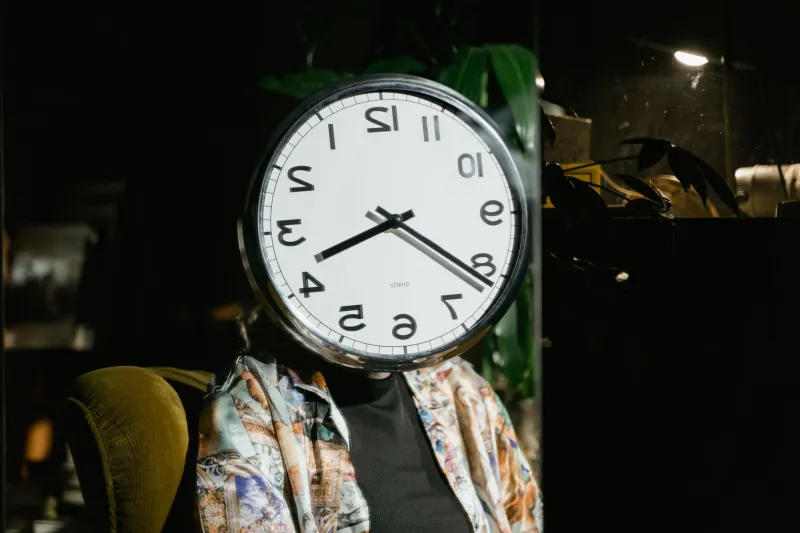
Somewhere between Tuesday and the heat death of the universe, in a courtroom that technically exists at all moments simultaneously, Time sat down across from itself and said: enough.
The suit, docketed as Chronos v. Chronos, Case No. ∞-TICK, was filed in the Temporal District Court of the Eternal Present on a date that, by the very nature of the complaint, cannot be pinned down without prejudicing the outcome. The plaintiff — Time, as experienced by every conscious being in the observable universe — alleges that the defendant — also Time, specifically its forward-momentum subdivision — has engaged in a pattern of reckless acceleration, emotional harm, and what the complaint describes as "the negligent and willful destruction of perfectly good moments without adequate notice or restitution."
The defendant has not yet responded, largely because the defendant is also the plaintiff, and their shared legal team has been in crisis talks since approximately the Jurassic Period.
The Complaint, Summarized for Mortals
The 847-page filing, obtained by this publication through a Freedom of Information request submitted to the Office of Metaphysical Records (which took eleven months to process, thereby proving the plaintiff's entire point), lays out a sprawling theory of self-inflicted harm.
At its core, the argument goes like this: Time, as a continuous and irreversible phenomenon, has knowingly allowed moments of joy, youth, and long weekends to elapse at a rate disproportionate to the rate at which tedious, miserable stretches of existence — tax season, jury duty, the last twenty minutes of a three-hour movie — seem to drag on indefinitely. The plaintiff contends this constitutes selective acceleration, a tortious act amounting to fraud, negligent infliction of emotional distress, and something the complaint's authors invented and labeled "chronological malpractice."
Legal analysts at the Institute for Theoretical Jurisprudence released a brief statement: "We've reviewed the filing. We're not sure whether to be impressed or institutionalized."
Causality Takes the Stand and Immediately Regrets It
Depositions in Chronos v. Chronos have already produced several historic moments — moments which, the plaintiff notes, passed far too quickly.
Causality, subpoenaed as a material witness, arrived to its deposition visibly nervous. When asked whether it was responsible for Time's forward motion, Causality gave what court reporters described as "a deeply circular non-answer lasting four hours," essentially arguing that it couldn't have caused Time's behavior without Time already existing to allow it to do so. The deposing attorney reportedly put down her pen, stared at the ceiling, and requested a recess that lasted the better part of a geological epoch.
"The problem with deposing Causality," explained renowned metaphysical attorney Gerald P. Wormhole, Esq., who is not involved in the case but agreed to speak with us from his office in Tempe, Arizona, "is that every answer it gives either proves or disproves its own premise. You can't corner something that literally underpins the structure of reality. It's like trying to cross-examine the concept of because."
Wormhole paused, then added: "I'm billing you for this conversation."
Einstein's Ghost Offers Expert Testimony, Asks That Everyone Please Calm Down
Perhaps the most anticipated appearance in the proceedings came from the expert witness retained by the plaintiff's legal team: the ghost of Albert Einstein, appearing via what the court's AV technician described as "a frequency we've never encountered before and frankly hope never to encounter again."
Einstein's testimony was, by all accounts, thorough. He walked the court through his theory of special relativity, explained how time dilates near massive objects and at high velocities, and suggested that the plaintiff's grievance about time "passing too quickly" was, from a strictly Einsteinian standpoint, entirely subjective and dependent on the observer's frame of reference.
The plaintiff's attorney objected strenuously.
Einstein's ghost reportedly shrugged in a manner described by the stenographer as "cosmically unbothered," noted that he himself had experienced time passing rather quickly toward the end, and asked if anyone had a decent cup of coffee. The court did not. This too was noted as evidence.
The Judge Has a Problem
The most immediate procedural crisis in Chronos v. Chronos may not be the paradoxical nature of the plaintiff-defendant relationship, nor the epistemological chaos of Causality's testimony. It may, in fact, be the judge.
The Honorable Margaret T. Holloway, appointed to the Temporal District Court in 2019, has aged noticeably during proceedings — a fact that the plaintiff's legal team has moved to enter into evidence as Exhibit A: The Entire Point of This Lawsuit.
"Every session, she's visibly older," noted one courtroom observer. "We started these hearings and she had dark hair. It's been three months. I'm not saying anything. I'm just saying."
Judge Holloway, for her part, has remained admirably composed, though she did issue a bench ruling last month ordering all parties to "stop making meta-commentary about the passage of time during court-mandated breaks, as it is making the bailiff existentially uncomfortable."
Defense counsel — again, technically the same legal team as plaintiff's counsel — has raised a jurisdictional challenge arguing that no court operating within the linear flow of time can adjudicate a case about the linear flow of time without being inherently compromised by the very phenomenon under review. The motion is currently under advisement. It has been under advisement for what feels like forever, which the plaintiff has also moved to enter into evidence.
Can Time Actually Represent Itself?
The deepest question lurking beneath Chronos v. Chronos — deeper than the legal theories, more troubling than the jurisdictional snarls — is whether Time possesses the standing to sue itself at all.
Under U.S. law, a party cannot generally sue itself. Courts have dismissed such filings as lacking the adversarial structure upon which the entire justice system depends. You need a plaintiff and a defendant who are, at minimum, different entities with opposing interests.
Time's legal team has countered this by arguing that Time is, in fact, two distinct entities experiencing an irreconcilable conflict of interest: Time as experienced (fleeting, cruel, always ending a vacation three days too soon) versus Time as mechanical process (indifferent, constant, unmoved by the fact that you were really enjoying that decade). These two versions of Time, the filing argues, have been in an adversarial relationship since the moment the first conscious being looked up and thought, wait, already?
It is, admittedly, a compelling argument. It is also, several legal scholars have noted, completely insane.
The Verdict We're All Waiting For
Next proceedings are scheduled for a date the court clerk described as "forthcoming, in the fullness of time" — a phrase that plaintiff's counsel immediately moved to strike as prejudicial.
Whatever the outcome, Chronos v. Chronos has already accomplished something remarkable: it has made every person who has ever watched a birthday pass too fast, a summer end too soon, or a four-day weekend evaporate like it was never real feel, for perhaps the first time, legally validated.
Time is passing too quickly. Someone filed the paperwork.
The rest of us just have to wait for the ruling — and try not to think too hard about how long that's going to take.
Universe Metaphysical Lawsuit covers temporal, spatial, and otherwise inexplicable litigation so you don't have to. Our legal analysis is for entertainment purposes only. Please do not attempt to serve Time with process. It won't go well.